
Which electric commercial vehicles have the best value for money?
You can find the best value for money in electric commercial vehicles by comparing total lifetime costs, not just the purchase price. Compact models often offer the best value for city distribution, while medium-sized vans perform best for versatile business applications. Switching to electric becomes financially attractive from around 15,000 kilometres per year.
What determines the value for money of electric commercial vehicles?
The value for money of electric commercial vehicles is determined by six main factors: purchase price, range, charging speed, maintenance costs, battery life and practicality. Together, these factors determine how much value you get for your investment over its entire useful life.
The purchase price is the starting point, but look beyond that initial amount. Electric commercial vehicles often cost more to buy than diesel versions, but compensate for this through lower operating costs. Since January 2025, this difference has become even smaller with the introduction of BPM tax on fuel vehicles.
The range determines how practical the vehicle is for your operations. For urban distribution, 150-200 kilometres is often sufficient, while regional services require 300+ kilometres. Charging speed affects daily practicality: fast charging 10-80% in 30-45 minutes makes in-between charging practical.
Maintenance costs are structurally lower in electric vehicles due to fewer moving parts: no oil changes, less wear and tear on brakes due to regenerative braking and simpler powertrains. A battery life of 8-10 years with guarantees of up to 160,000 kilometres provides certainty about long-term costs.
Which electric commercial vehicles currently offer the best value for money?
In the compact category vehicles such as the Renault Kangoo E-Tech and Peugeot e-Partner offer excellent value through their combination of practical cargo space, reliable range of 250-280 kilometres and competitive pricing. These models are ideal for local distribution and services.
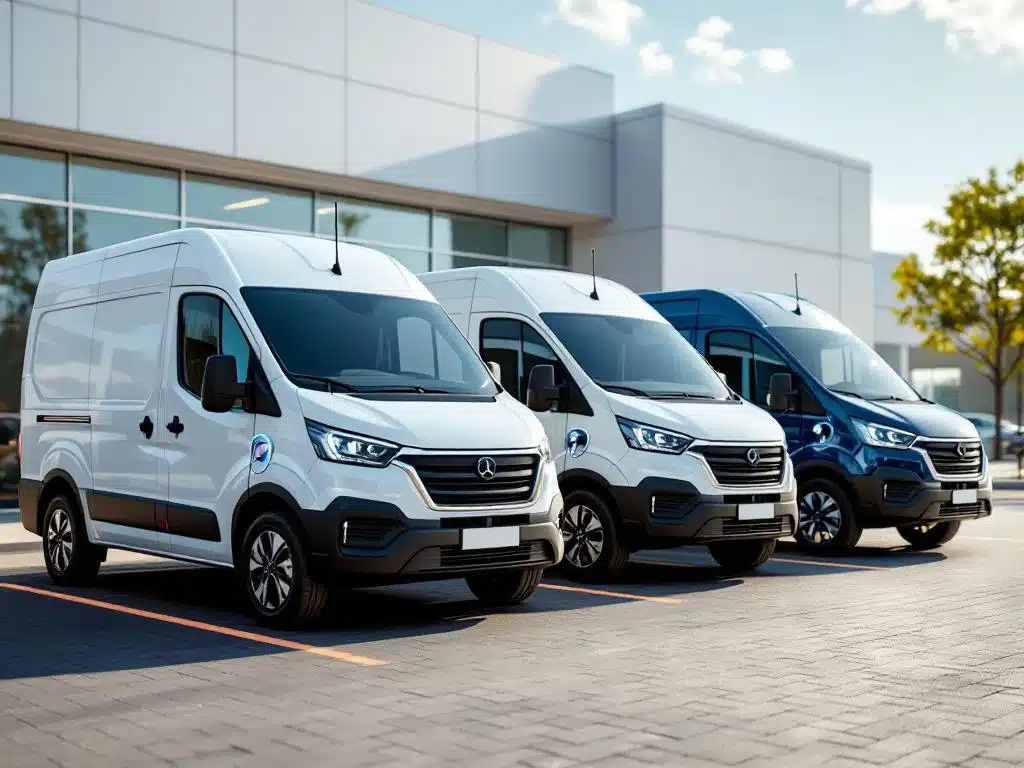
For medium-sized commercial vehicles, models such as the Ford E-Transit Custom and Mercedes eVito dominate the market. They offer a range of 350+ kilometres, fast-charging facilities and sufficient charging capacity for most business applications. Their price-performance ratio is strong due to proven reliability and extensive dealer networks.
In the large van category, the Ford E-Transit currently offers the best value. With different battery options (68 kWh and 77 kWh), load capacities of up to 1,600 kg and a range of up to 350 kilometres, it suits a variety of business needs. The purchase price is competitive and maintenance costs remain manageable through Ford's extensive service network.
When making your choice, look in particular at the match between range and your daily routes, the charging capabilities at your business location and the availability of service in your region. These practical factors ultimately determine the real value more than specifications on paper.
How do you calculate the total cost of an electric company car?
The Total cost of ownership (TCO)-calculation gives the actual cost over the entire useful life. Add up the purchase price, energy costs, maintenance, insurance and depreciation, and subtract any subsidies and tax breaks.
Start with the purchase price minus the residual value after your planned period of use. Electric commercial vehicles retain their value reasonably well due to increasing demand and improved battery warranties. For depreciation, count about 15-20% per year for the first five years.
Energy costs are calculated by dividing your annual mileage by consumption (usually 20-25 kWh/100 km) and multiplying this by your electricity tariff. With home charging, you pay your regular rate, with public charging often €0.40-0.60 per kWh. Business charging at your company is usually the most advantageous.
Maintenance costs are 30-40% lower than for diesel vehicles. Count around 0.08-0.12 euros per kilometre for periodic maintenance, tyres and minor repairs. Insurance costs similar amounts, sometimes slightly more due to the higher purchase value.
Don't forget the tax benefits: no BPM on purchase, low addition for private use and deductible energy costs. These benefits can save hundreds to thousands of euros annually, depending on your situation.
When is an electric company car more financially interesting than diesel?
The tipping point is usually around 15,000-20,000 kilometres per year, depending on fuel prices and your specific driving pattern. At higher annual kilometres, the lower operating costs of electric driving become noticeable faster and offset the higher purchase price.
Urban distribution with a lot of stop-start traffic makes electric rather interesting due to regenerative braking and efficiency at low speeds. Diesel engines perform worse in the city and require more maintenance due to particulate filter problems on short trips.
At fuel prices above EUR 1.50 per litre, electric driving becomes more financially attractive. With electricity prices of 0.25 euros per kWh, electric driving costs around 0.05-0.07 euros per kilometre, while diesel costs 0.10-0.15 euros per kilometre, depending on consumption and prices.
Leasing often makes electric rather interesting due to staggered costs and inclusive maintenance packages. Financial leasing with a term of 4-5 years spreads the higher purchase price over more years, making monthly costs comparable to diesel alternatives.
Also consider future developments: environmental zones are becoming stricter, fuel prices are structurally rising and electric vehicles are becoming cheaper. What breaks even now will become increasingly advantageous for electric in the coming years.
How Van den Hurk helps with electric commercial vehicles
We will help you find the right electric commercial vehicles choose one that perfectly suits your business needs and budget. With our 60 years of experience in the commercial vehicle industry, we understand that switching to electric requires careful consideration.
Our approach includes:
- Personal advice - We analyse your driving patterns, charging options and business requirements
- TCO calculation - Transparent cost comparison between electric and traditional drives
- Large stock - Electric commercial vehicles of various brands readily available
- Flexible financing - Financial lease options that make electric driving accessible
- Complete unburdening - From advice to delivery, all under one roof
We take the time to understand your situation and offer tailor-made solutions with no strings attached. Whether you need one electric company car or want to make your entire fleet sustainable, we will help you think about the best approach for your business.
Curious about the possibilities for your business? Contact us for a no-obligation discussion about electric commercial vehicles that really suit you.