
Which electric commercial vehicles are suitable for retail?
For the retail sector, its electric commercial vehicles with ample cargo space and a reliable range are the best choice. Compact models like the Renault Kangoo E-Tech are perfect for city deliveries, while larger vehicles like the Mercedes eVito offer more volume for bulkier transports. The choice depends on your delivery area, the type of goods and your daily mileage.
Why are more and more retailers opting for electric commercial vehicles?
Retailers are switching to electric commercial vehicles because of lower operating costs, access to environmental zones and a better corporate image. Electric vehicles have lower maintenance costs due to the lack of complex engine parts and offer quiet deliveries, which are especially appreciated in urban areas.
The financial benefits are significant. Since January 2025, BPM is levied on diesel company cars, making electric alternatives more advantageous. You save on fuel and maintenance costs and benefit from several tax advantages, such as a lower addition rate.
For your corporate image, electric company cars make a positive impression on customers. More and more consumers appreciate sustainable business practices. Moreover, electric vehicles allow you to access environmental zones closed to diesel vehicles, increasing your delivery options.
Which electric commercial vehicles have enough cargo capacity for retail?
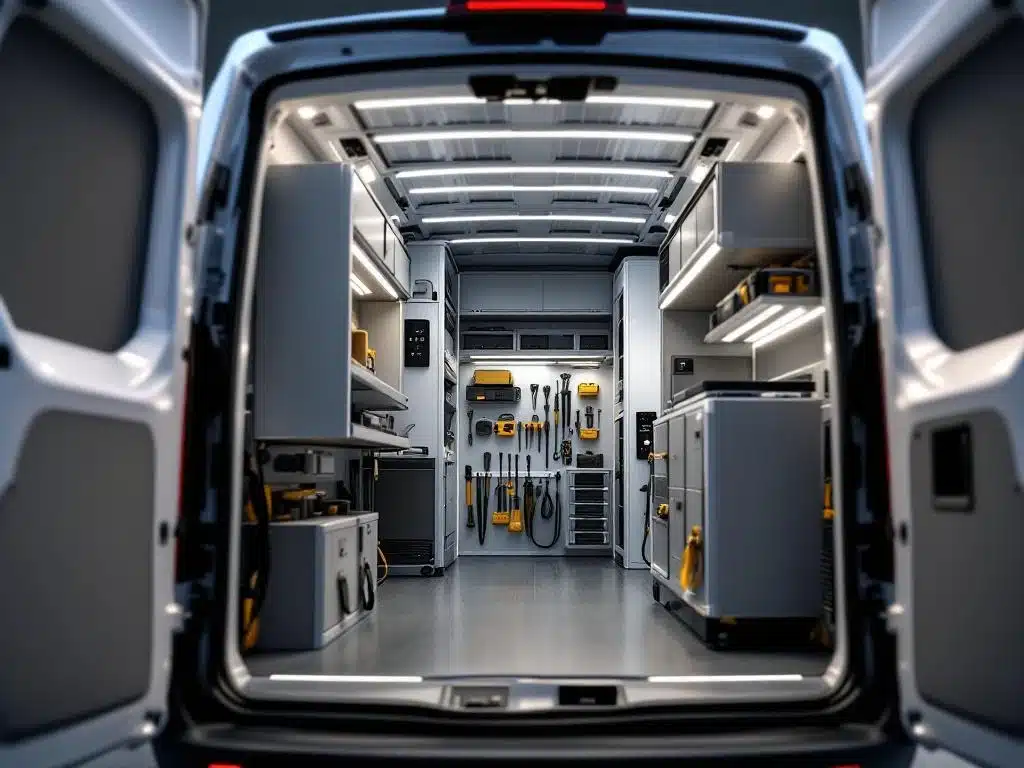
For the retail sector, electric commercial vehicles are available with load volumes ranging from 3 to 17 cubic metres. Compact models such as the Citroën ë-Berlingo offer 3.3 m³ of cargo space and are ideal for small parcels and urban deliveries. For larger volumes, you can opt for vehicles like the Ford E-Transit with up to 15.1 m³ of cargo space.
Weight capacity ranges between 600 kg for compact models and 1,700 kg for larger vans. For clothing shops transporting mainly light goods, smaller models suffice. Electronics shops often need more protection and may benefit from vehicles with fixed partitions.
For the food sector, specialised refrigerated trucks are available in electric versions. These maintain their cooling capacity without running the motor, saving energy. When making your choice, pay attention to practical aspects such as the loading sill height and the number of doors for efficient loading and unloading.
How far can you drive an electric company delivery vehicle?
Modern electric commercial vehicles have a range of between 200 and 400 kilometres, depending on the model and battery capacity. For most retailers with local or regional deliveries, this is more than enough. Compact models often achieve 250-300 km, while larger vans usually travel 200-250 km on a single charge.
Actual driving range is affected by several factors. Cold weather can reduce range by 20-30%, while air conditioning or heating also consumes energy. Your driving style makes a lot of difference: accelerating slowly and anticipating traffic helps maximise range.
For your delivery routes, you can easily calculate whether the range is sufficient. Add up your daily kilometres and keep 20% in reserve for unforeseen circumstances. Most retailers drive between 80 and 150 km per day, which is well within the range of electric commercial vehicles.
What is the cost of electric commercial vehicles versus diesel?
Electric commercial vehicles have higher acquisition costs but lower operating costs than diesel vehicles. Over a four-year period, total costs are often similar or even lower for electric models. On average, the payback period is between 2 and 4 years, depending on your annual mileage.
Energy costs per kilometre are significantly lower. Whereas with diesel you pay around €0.15-0.20 per kilometre on fuel, electricity often costs €0.05-0.08 per kilometre. At 20,000 km per year, this saves €2,000-3,000 in fuel costs.
Maintenance costs are lower in electric vehicles 30-50%. There is no oil to change, no exhaust that can rust and the brakes wear less due to regenerative braking. Insurance premiums are often similar, but some insurers offer discounts for electric vehicles.
Don't forget to factor in the tax benefits. Electric company cars have a lower addition rate and you can benefit from various subsidies and tax breaks that further reduce the overall cost.
How we help with electric commercial vehicles
We support retailers in the transition to electric commercial vehicles with personal advice and flexible solutions. With more than 60 years of experience, we understand which vehicles best suit your specific delivery needs and operations.
Our service includes:
- Personal consultation to choose the right electric company car
- Transparent comparison of costs between electric and diesel alternatives
- Flexible leasing options to suit your cash flow and growth plans
- Support in applying for grants and tax benefits
- Aftercare and service for carefree electric driving
With our large stock and strong regional presence, we ensure that you can quickly switch to sustainable business mobility. Contact us for a no-obligation discussion about the possibilities for your retail business.