
What are the safety requirements for electric commercial vehicles?
Electric commercial vehicles must meet various safety requirements to be legally allowed on the road. This includes mandatory certifications such as CE marking and type approval, specific battery safety requirements and adapted maintenance procedures. There are also strict requirements for on-site charging stations to prevent fire and explosion hazards.
What certifications do electric commercial vehicles need?
Electric commercial vehicles have a type approval and CE marking required to be admitted to road traffic in the Netherlands. These certifications prove that the vehicle meets European safety standards for electric vehicles and their high-voltage systems.
Type approval verifies that the electric commercial vehicle meets all technical requirements for brakes, lighting, construction and electromagnetic compatibility. For electric vehicles, additional checks are added for the battery system, charging connection and high-voltage protection.
Business vehicles are subject to the same basic requirements as private cars, but there are additional requirements:
- Load capacity and connections suitable for intensive use
- Workshop safety during maintenance by mechanics
- Documentation for fleet management and insurance
- Declarations of conformity for leasing and finance companies
When purchasing, always check that all certificates are present. Vehicles without valid type approval are not allowed on public roads and are not insurable.
How to prevent fire and explosion hazards in electric commercial vehicles?
Prevent fire and explosion hazards by proper charging procedures and regularly check the battery and charging cables for damage. Use only certified charging cables and charging stations suitable for your vehicle type.
Pay attention to these warning signs that may indicate dangerous situations:
- Strange odours during loading (sweet, chemical or burning smell)
- An unusually warm battery or charging cable
- Smoke development around the battery or charging connection
- Dashboard error messages about the battery system
- Distortion or swelling of the battery housing
Special procedures are required in emergencies involving electric commercial vehicles. Switch off the vehicle via the emergency switch (usually near the driver) and keep at least 3 metres away. Call 112 immediately and mention that it is an electric vehicle.
Provide a special fire extinguisher suitable for electrical fires (class C) in the workplace. Normal water extinguishers are dangerous for electrical fires because of the risk of electrocution.
What are the maintenance requirements for batteries of electric commercial vehicles?
Electric utility vehicle batteries require annual professional audits of the battery management system, cooling system and high-voltage connections. Software updates should be installed regularly to maintain optimal performance and safety.
These maintenance checks are mandatory for electric commercial vehicles:
- Testing battery capacity and charging performance
- Checking the cooling system for leaks and fluid levels
- Inspecting high-voltage cables for wear
- Updating the battery management system software
- Measuring the insulation resistance of the electrical system
Daily maintenance you can do yourself by monitoring the battery temperature through the dashboard. Avoid fully discharging the battery and preferably charge between 20% and 80% for optimal battery life.
Professional inspection is required when:
- Driving range decreases noticeably
- Loading is slower than normal
- Error codes appear on the dashboard
- The battery becomes unusually warm
Have maintenance carried out only by mechanics certified for high-voltage systems. Improper maintenance can lead to dangerous situations and loss of warranty.
What are the charging station requirements for safe charging at work?
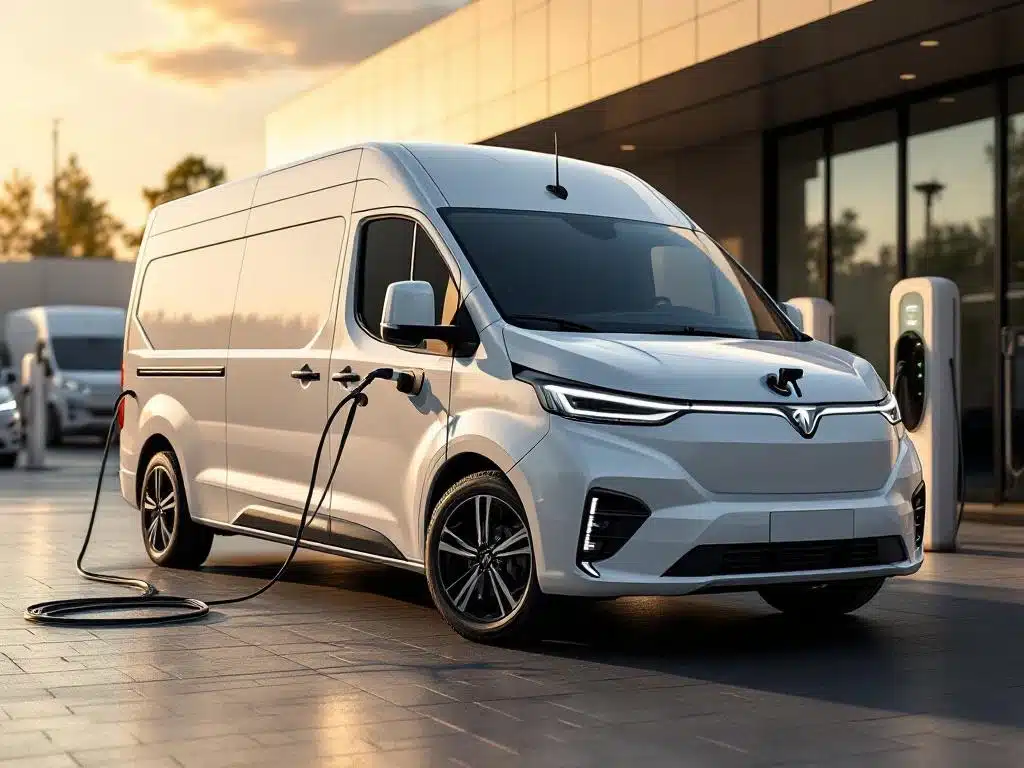
Workplace charging stations must be installed by a certified electrician and comply with NEN 1010 standards for electrical installations. They need a separate group with earth leakage protection and must be weatherproof.
These technical requirements apply to business charging stations:
- Minimum IP54 dust and splash water protection
- An earth leakage circuit breaker of no more than 30 mA
- A separate fuse group for the charging station
- Sufficient cable length for flexible parking
- An emergency stop button at your fingertips
Outdoor installations require additional requirements, such as UV-resistant cabling and frost protection. Place charging stations at least 1.5 metres from combustible materials and ensure good ventilation in enclosed areas.
Check monthly whether:
- The earth leakage circuit breaker is working correctly (test button)
- Charging cables have no damage
- The housing is clean and dry
- All connections firmly in place
Have the charging station inspected annually by an approved installer. This is often mandatory for insurance purposes and may be required by law, depending on your business situation.
How Van den Hurk helps with safe electric commercial vehicles
We help you find fully certified electric commercial vehicles that meet all safety requirements. Our vehicles have the right type approval and certifications, so you can hit the road safely right away.
Here's how we support you:
- Advice on which safety requirements apply to your business situation
- Verification of all necessary certifications and documents
- Explanation of maintenance requirements and warranty conditions
- Referral to certified installers for charging stations
- Support in drafting safety protocols
View our offer electric commercial vehicles and find out which vehicles best suit your safety requirements. Get in touch for personal advice on transitioning to safe electric driving for your business.