
What is the range of electric commercial vehicles?
The range of electric commercial vehicles varies between 150 and 400 kilometres, depending on the model and battery capacity. Compact vans typically achieve 200-300 kilometres, while larger models reach around 150-250 kilometres. Factors such as weather, load weight and driving style significantly affect the actual range. This guide answers all questions on the range and practical use of electric commercial vehicles.
How many kilometres can you drive with an electric company car?
Modern electric commercial vehicles achieve between 150 and 400 kilometres on a single battery charge. Compact models such as the Volkswagen e-Crafter reach 200-300 kilometres, while medium-sized vans usually achieve 250-350 kilometres. Larger vans are often around 150-250 kilometres due to their higher weight and size.
Battery capacity largely determines your range. Electric commercial vehicles typically have batteries between 35 kWh and 100 kWh. A 50 kWh battery will give you around 200-250 kilometres of range, while a 75 kWh battery will allow up to 350 kilometres.
In practice, you often get 80-90% of the stated WLTP value. This means that a commercial vehicle with 300 kilometres declared range realistically achieves 240-270 kilometres. Therefore, always plan your routes with a safety margin of at least 20%.
What factors influence the range of electric commercial vehicles?
Weather conditions have the biggest impact on your range. Cold temperatures below 5°C can reduce your range by 20-30% as the battery works less efficiently. Hot days above 30°C also cost extra energy by using the air conditioner, usually 10-15% less range.
Your load weight also plays an important role. Every 100 kg of extra weight costs about 3-5% of range. A fully loaded commercial vehicle therefore consumes 15-25% more energy than an empty one. Also pay attention to the air resistance of loads protruding outside the body.
Your driving style determines how many kilometres you get out of your battery. Aggressive acceleration and hard braking can increase your consumption by 20-40%. Highway driving at speeds above 100 km/h consumes exponentially more energy. At 120 km/h, you use about 30-40% more power than at 90 km/h.
The type of terrain also makes a difference. Hilly terrain takes extra energy when climbing, although regenerative braking on descents recovers some. City driving is usually most efficient due to lower speeds and plenty of braking opportunities.
How long does it take to charge an electric company car?
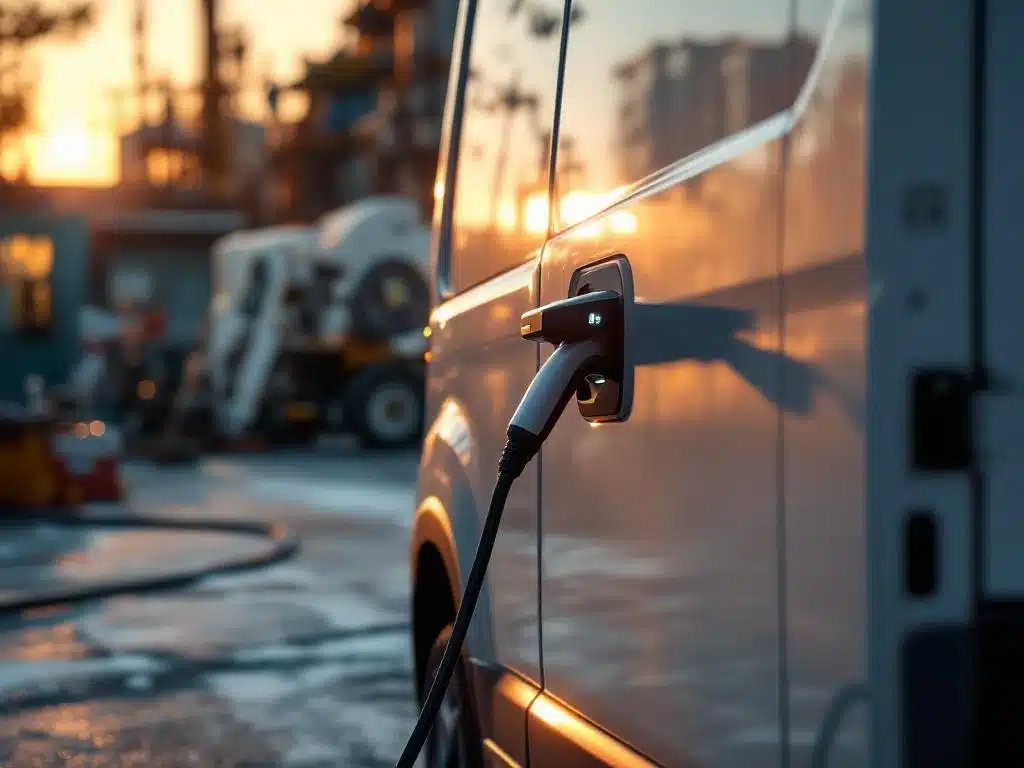
Home charging at a wallbox (11 kW) takes 4-8 hours for a full charge, depending on your battery capacity. A 50 kWh battery fully charges in about 5 hours. Charging at an ordinary power socket (2.3 kW) takes 15-25 hours and is only suitable for emergencies.
Public charging stations usually offer 11-22 kW of power. At a 22 kW charging station, your commercial vehicle will fully charge in 2-4 hours. This speed is ideal for charging during working hours or longer stops.
Fast chargers along highways provide 50-150 kW and charge your battery from 10% to 80% in 30-60 minutes. The final 20% is always slower to protect the battery. So plan fast-charging sessions to 80% for best time efficiency.
For business use, it is best to plan fixed charging times. Charge at home or at the office at night when rates are low. Use fast chargers only for longer trips or unexpected situations.
What can you do to increase the range of your electric utility vehicle?
Eco-driving can increase your range by 20-30%. Accelerate gradually, anticipate traffic lights and maintain a constant speed. Use cruise control on motorways and drive no faster than 100 km/h whenever possible.
Regenerative braking helps recover energy. Put your commercial vehicle in the strongest regeneration mode and let it coast instead of braking hard. In the city, you can recover up to 15% of your energy by smart anticipation.
Optimise your climate control. Heat or cool your cabin during charging so that the battery does not have to jump in. Use seat heating instead of cabin heating whenever possible; it uses less energy.
Keep your tyres properly inflated and avoid unnecessary ballast. Low tyre pressure causes 3-5% extra consumption. Remove heavy items you don't need and dismantle roof racks when not in use.
Plan your routes smartly with charging stops. Use apps that take into account your current battery level, weather conditions and available charging stations. Avoid detours by planning your charging stops in advance.
How Van den Hurk helps with electric commercial vehicles
We help you choose the right electric commercial vehicle that perfectly suits your daily mileage and work needs. With our large stock of electric commercial vehicles you will always find a model that meets your range requirements.
Our service includes:
- Personal advice on range and charging options for your situation
- Flexible leasing options that make the switch to electric driving affordable
- Transparent information on actual consumption and range
- Support in finding suitable charging solutions
- Customised equipment and accessories for optimal use
With more than 60 years of experience, we understand that switching to electric driving requires careful planning. We work with you to calculate whether an electric company car is suitable for your routes and give honest advice on the options.
View our complete range electric commercial vehicles and find out which models best suit your business needs. Contact us for personal advice on range and the right choice for your situation.