
What charging infrastructure do you need when leasing an electric company car?
Electric commercial vehicle leasing is becoming increasingly popular amongst business owners and fleet managers in the Netherlands. The benefits are clear: lower fuel costs, reduced emissions and attractive tax benefits. But before you take the plunge into electric commercial vehicle lease, there is one topic you mustn’t overlook: the charging infrastructure. After all, an electric company car without a proper charging solution will soon come to a standstill.
In this article, we answer the most frequently asked questions about charging infrastructure for electric commercial vehicles. Whether you’re just starting to think about a electric company minibus with a double cab, or if you’re looking to make a small fleet more sustainable: here you’ll find practical answers to help you on your way.
What is charging infrastructure and why is it important for electric commercial vehicle leasing?
Charging infrastructure refers to all the equipment, cabling and systems used to charge an electric vehicle. For electric company car leasing, this includes the charging point or wallbox, the power connection, any smart charging software and the associated installation. Without a good charging infrastructure, you cannot rely on an electric company car.
With a conventional car with a combustion engine, you simply drive to a petrol station. With an electric commercial vehicle, things work differently: charging is mostly done at fixed locations, such as at home, on company premises or at a public charging point. How and where you charge largely determines how practical the vehicle is in everyday use. A poor charging solution leads to unexpected downtime, lost working hours and frustration.
With a lease contract for an electric company car, the charging infrastructure is therefore not a minor consideration. It is an integral part of your mobility solution. Those who organise this properly in advance will reap the benefits of smooth business operations every day.
What types of charging solutions are available for electric commercial vehicles?
There are three main categories of charging solutions for electric commercial vehicles: home charging using a wallbox, on-site charging using a business charging point, and public charging via a charging network. Which solution suits you best depends on your driving habits, the distances you travel and your place of work.
Charging at home with a wallbox
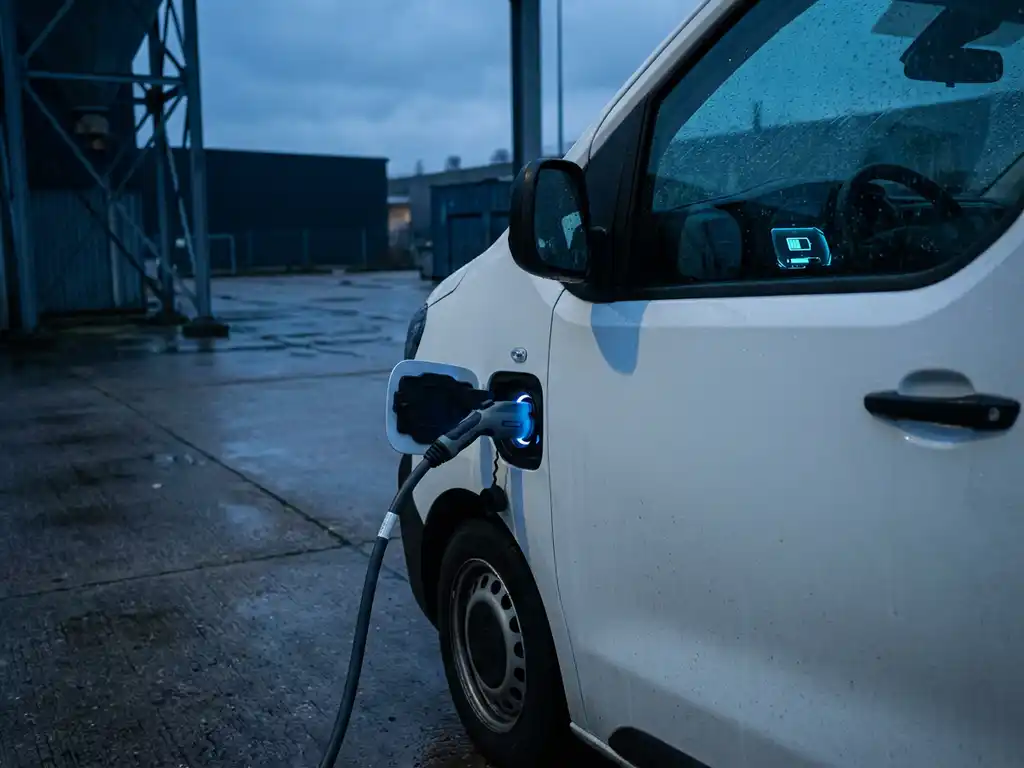
A wallbox is a compact charging unit that you mount on the wall, either at home or at a business premises. They typically provide a charging capacity of 3.7 to 22 kW, which means that most electric company cars can be fully charged overnight. This is the most common solution for drivers who return home in the evening and set off again the next morning with a fully charged battery.
Commercial charging points on company premises
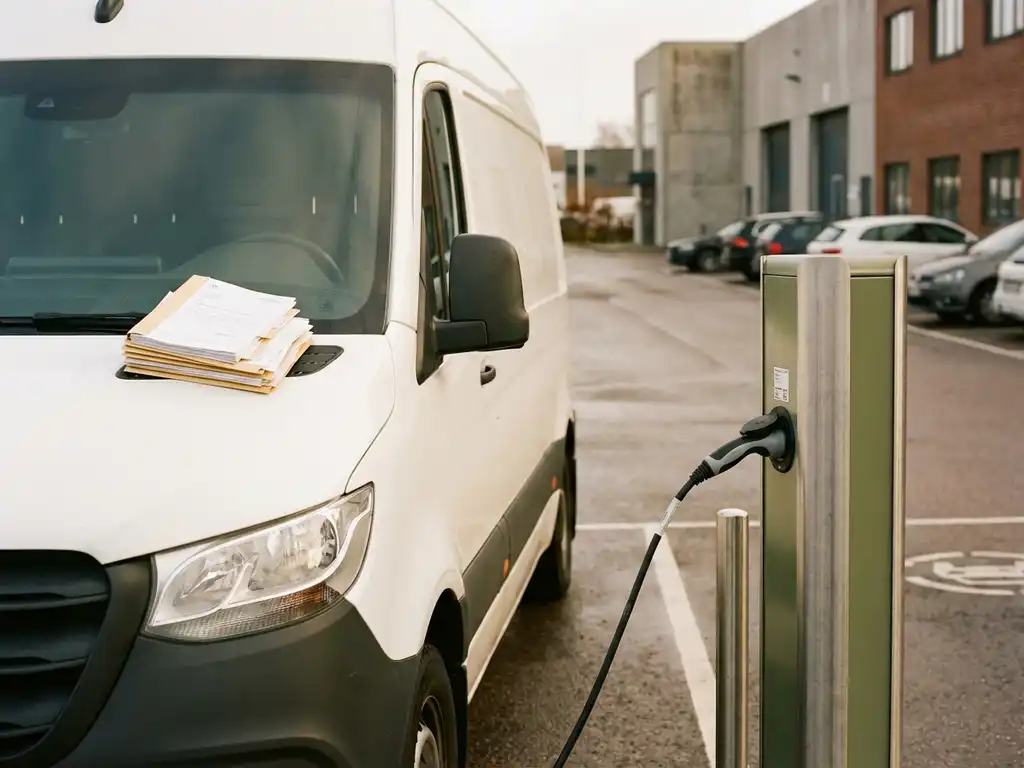
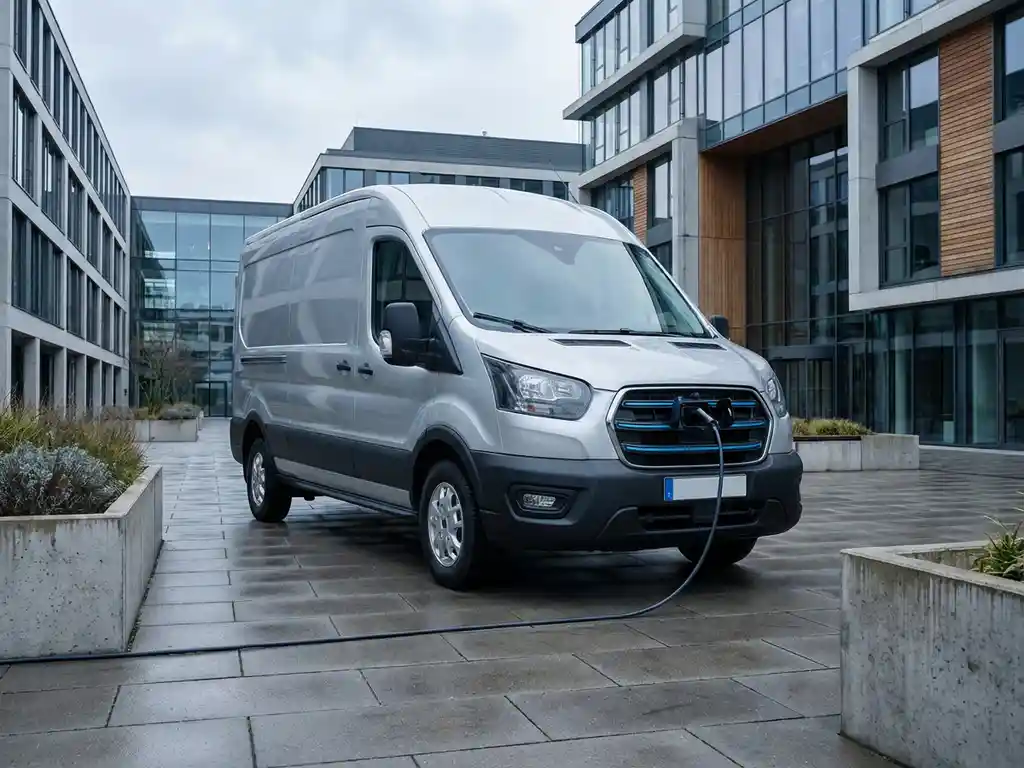
For businesses with multiple electric vehicles, such as a small van and a double-cab company minibus, an on-site business charging solution is often the most efficient choice. You can install multiple charging points, link them to a smart energy management system and thus optimise charging costs. Smart charging software then ensures that vehicles charge at the cheapest times, for example at night when electricity prices are low.
Public charging
Public charging points are useful as a supplement, but rarely as the primary charging solution for company cars. They are available via networks such as Allego, Fastned or the local authority’s charging infrastructure. Fast chargers (DC charging) can charge an electric company car to 80 per cent in 30 to 60 minutes, which is handy when on the road. However, for day-to-day business use, public charging is less reliable and generally more expensive than charging at home or at the office.
As a leaseholder, do you have to arrange for a charging point yourself?
As a lessee, you are usually responsible for arranging a charging point yourself, unless the leasing company offers an all-inclusive package that includes charging infrastructure. Some lease contracts include a charging solution as an option; others offer it as a standard feature of an electric vehicle lease package.
It is advisable to check this thoroughly in advance when taking out a lease agreement. Ask specifically whether the installation of a wallbox is included, whether there is a charge for home charging, and whether the contract includes a charging card for public charging. Many leasing companies work with specialist installers who will fit the wallbox at your home or business premises.
If you are a self-employed person or an SME leasing an electric company car, it is also worth noting that your employer or client may sometimes offer a contribution towards the purchase and installation of a home charging point. This varies from case to case, but it is worth looking into this before you incur any costs yourself.
How much does charging infrastructure cost for an electric company car?
The costs of charging infrastructure for an electric company car vary considerably, depending on the type of charging solution and the installation work required. A basic wallbox for home use typically costs between 800 and 1,500 euros, including installation. A business charging solution for company premises with multiple charging points can cost several thousand euros.
Factors that determine costs
- The charging capacity of the wallbox or charging point (the higher the capacity, the more expensive it is)
- The distance between the meter cupboard and the installation site
- Whether the electricity supply needs to be upgraded
- The number of charging points you wish to install
- Smart charging software or an energy management system
In addition to the purchase and installation costs, there are also running costs: the price of electricity per kWh and any subscription fees for a charging network or management software. Fortunately, there are various subsidy schemes and tax incentives available to businesses investing in charging infrastructure. These include the ISDE subsidy for commercial charging points and the option to reclaim VAT on the installation.
How do you charge an electric company car if you don’t have your own driveway?
If you don’t have your own driveway or business premises, you can charge an electric commercial vehicle using public charging points in the neighbourhood, a street charging point (which you can apply for from the local council), or a charging point at your place of work. This requires a bit more planning, but it’s certainly feasible.
Applying for municipal charging points
In many Dutch local authorities, you can apply for a street-side charging point if you own an electric vehicle but do not have your own parking space. The local authority will then install a charging point near your home. This is a free or low-cost solution, but there is sometimes a waiting period involved. Check with your local authority about the procedure and processing time.
Charging at the work site
If your company car is parked at a fixed work location during the day, charging on the company premises is a logical solution. You drive to work in the morning, the car charges during the day, and you drive home again in the evening. This works well for drivers with a fixed workplace and predictable driving patterns.
Public fast chargers as a supplement
For journeys where you need to recharge en route, public fast chargers are a useful option. You can easily pay for charging using a charging card or a charging network app. Please note that not all electric company cars are suitable for fast charging; always check this in the vehicle’s specifications.
What should you look out for when choosing charging infrastructure for your vehicle fleet?
When choosing charging infrastructure for a fleet, you should consider the charging capacity per vehicle, the available grid capacity at your site, the scalability of the system and the option for smart charging. A good charging solution scales with your fleet and keeps energy costs under control.
Network capacity and capacity expansion
One of the biggest practical challenges with commercial charging infrastructure is the available grid capacity. If you want to charge several electric vehicles at the same time, this will affect your electricity supply. An electrician or energy adviser can assess whether your supply is sufficient or whether you need to upgrade it. This can be time-consuming, so plan well in advance.
Smart charging and energy management
Smart charging means that the charging software automatically adjusts charging times and charging power to match the available grid capacity and energy prices. This prevents peak loads on the grid and reduces your energy bill. For a fleet of more than two or three vehicles, a smart charging system is almost always worthwhile.
Scalability
Choose a charging solution that you can scale up as your fleet grows. Some systems allow you to easily add extra charging points without having to re-install the entire infrastructure. This saves costs in the long term and makes the transition to more electric vehicles a lot smoother.
Management and reporting
For fleet managers, insight into charging behaviour is of great importance. Modern charging systems offer dashboards that allow you to see, for each vehicle, how much has been charged, what the costs are and whether there have been any faults. This makes cost control and planning a great deal easier.
How we can help you with electric commercial vehicle leasing and charging infrastructure
We understand that the switch to electric driving involves more than just choosing a vehicle. Charging infrastructure is a key part of that decision, and we’re here to provide you with practical help.
- We have a a wide range of electric commercial vehicles, from small vans to double-cab commercial vans
- We’ll work with you to find the right charging solution to suit your driving habits and place of work
- We offer flexible leasing options where charging infrastructure can be included as part of the package
- Our advisers know the region well and are familiar with the opportunities available locally
- We’ll guide you every step of the way, from the initial consultation right through to delivery, so you can get started straight away
Would you like to find out which electric commercial vehicle best suits your needs and how to set up your charging infrastructure in the most efficient way? Please get in touch with us for a no-obligation consultation. We’d be happy to help.