
Which electric commercial vehicles are available for lease?
Electric commercial vehicles are becoming increasingly popular amongst business owners who want to save on fuel costs, operate more sustainably or need to comply with emissions standards in city centres. Leasing also makes the switch to electric driving more accessible: you spread the costs, avoid a large upfront investment and always drive a vehicle that suits your business. In this article, we answer the most frequently asked questions about leasing an electric company car, so that you can make an informed choice.
Whether you’re looking for a electric company car lease, whether you’re looking to buy a small van or want information about a double-cab commercial van: there’s an ever-increasing range of options on the market. Below you’ll find answers to all the questions you might have as a business owner.
Which electric commercial vehicles are available to lease?
When it comes to electric commercial vehicle leasing, models are now available in virtually every segment: from compact vans for urban distribution to larger panel vans and double-cab commercial buses. Well-known models include the Volkswagen ID. Buzz Cargo, Renault Kangoo E-Tech, Citroën ë-Berlingo, Ford E-Transit, Mercedes-Benz eSprinter and the Fiat E-Ducato.
Small electric vans
For business owners who do a lot of driving in the city, a small electric van is a practical choice. Models such as the Renault Kangoo E-Tech, Opel Combo-e and Peugeot e-Partner offer sufficient load space for daily delivery routes and are compact enough for narrow streets and car parks. They are similar to those in the ‘small van’ segment, but are fully electric and available on a lease basis, without any significant upfront costs.
Medium-sized and large electric vans
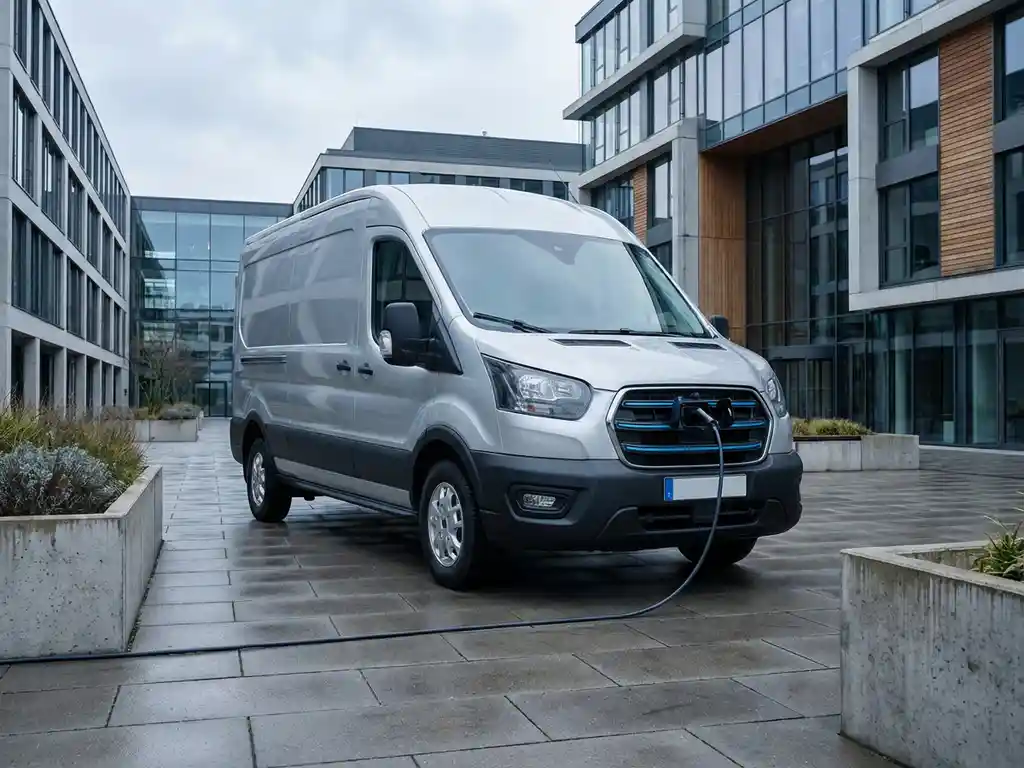
For heavier duties, there are larger options, such as the Ford E-Transit, Mercedes-Benz eSprinter and Renault Master E-Tech. These vehicles offer a higher payload and greater driving range, making them suitable for logistics companies and contractors. The electric commercial van with double cabin is becoming increasingly common, making it ideal for businesses that need to transport both people and goods.
The range is growing rapidly. Almost every major car manufacturer is now launching an electric version of its most popular commercial vehicle, which means that, as a business owner, you have an ever-increasing choice when putting together your fleet.
What are the benefits of leasing an electric company car?
Leasing an electric commercial vehicle offers several tangible benefits compared to buying one or driving a fossil-fuelled vehicle. You benefit from lower running costs, tax breaks, access to low-emission zones and a predictable monthly budget, without the need for a large upfront investment.
- Lower fuel costs: Electricity is cheaper than diesel or petrol, especially if you charge using solar panels or during off-peak hours.
- Tax benefits: Electric commercial vehicles are eligible for favourable additional tax rates and, in some cases, subsidies, such as the SEBA scheme for business users.
- Access to environmental zones: More and more cities are introducing zero-emission zones. With an electric company car, you can always drive in them without incurring fines or having to take a detour.
- Not a major purchase: With a lease, you spread the costs over the term of the lease and keep your working capital free for other investments.
- Always a modern vehicle: At the end of the lease term, you can easily switch to a newer model with a longer range or better technology.
- Less maintenance: Electric motors have fewer moving parts than internal combustion engines, which generally results in lower maintenance costs.
Leasing is also attractive because you can tailor your monthly payments to your usage. If you opt for an operational lease, maintenance and insurance are often included, which further reduces the administrative burden.
How much does it cost to lease an electric company car?
The monthly lease payment for an electric commercial vehicle is roughly between 400 and 1,200 euros per month, depending on the model, the lease term, the annual mileage and whether you opt for a finance or operating lease. Smaller models such as the Renault Kangoo E-Tech start at the lower end of that range; larger vehicles such as the Ford E-Transit are at the higher end.
Factors that determine the lease price
The price you pay for an electric company car lease depends on several factors:
- Purchase price of the vehicle: Electric commercial vehicles often have a higher list price than comparable diesel models, which is reflected in the monthly instalment.
- Residual value: The expected residual value at the end of the lease term affects the monthly costs. A higher residual value means a lower monthly payment.
- Duration: A longer lease term (48 or 60 months) generally reduces the monthly cost compared with a shorter term.
- Annual mileage: More kilometres per year means a higher monthly charge, as the vehicle wears out more quickly and has a lower residual value.
- Services included: With an operational lease, maintenance, insurance and breakdown cover are often included, which increases the cost but also offers greater peace of mind.
Always compare the total costs over the entire term, including energy costs and any charging infrastructure, to get a fair picture of what electric leasing actually costs you.
What is the difference between a finance lease and an operational lease for company cars?
The difference between a finance lease and an operational lease lies in ownership, risk and what is included in the contract. With a finance lease, you finance the purchase of the vehicle and ultimately become the owner. With an operational lease, you hire the vehicle for a fixed period and return it at the end, without any transfer of ownership.
Financial lease
With a finance lease, the vehicle appears on your company’s balance sheet. You pay a monthly instalment comprising capital repayment and interest. At the end of the lease term, you purchase the vehicle for a pre-agreed residual value. You are responsible for maintenance, insurance and any depreciation. This is a good option if you wish to own the vehicle in the long term or if you want to have the asset on the balance sheet for financing reasons.
Operational lease
An operational lease is more of an all-in-one solution. You pay a fixed monthly fee and the leasing company takes care of maintenance, insurance, road tax and, in many cases, breakdown cover. The vehicle does not appear on your balance sheet, which can be beneficial for your financial ratios. At the end of the lease term, you return the vehicle and choose a new model. For business owners who want peace of mind, an operational lease is often the most practical choice.
Which option suits you best depends on your cash flow situation, your preference for ownership and how much administrative responsibility you wish to take on yourself.
How far can an electric commercial vehicle travel on a single charge?
The driving range of an electric commercial vehicle is usually between 150 and 400 kilometres on a single charge, depending on the model, battery capacity, load and driving conditions. Smaller models achieve an average of 200 to 250 kilometres; larger vehicles with bigger batteries can reach 300 to 400 kilometres.
What factors affect the driving range?
The range specified by the manufacturer has been measured under ideal conditions. In practice, several factors come into play:
- Load: A fully loaded van uses more energy than an empty one, which reduces its range.
- Temperature: Cold winters significantly reduce battery performance. Expect your range to be 20 to 30 per cent lower in winter.
- Driving style: Accelerating quickly and driving fast on the motorway use more energy than driving at a steady, relaxed pace.
- Use of heating or air conditioning: Climate control draws extra power from the battery.
- Type of driving: City driving with lots of stops is often more efficient than motorway driving, thanks to regenerative braking.
For most day-to-day business journeys, such as local deliveries or service calls, the range of modern electric commercial vehicles is more than adequate. If you regularly drive long distances or need to make several journeys a day, it’s a good idea to carefully assess the charging options available at your location and along your route.
What should you look out for when choosing an electric company car on a lease?
When choosing an electric company car on lease, you should consider the driving range, the payload, the charging options, the total lease cost and the availability of charging infrastructure at and around your place of work. Ensuring the vehicle is well suited to its intended use will prevent disappointment later on.
A practical checklist to help you make the right choice
- Analyse your daily mileage: How many kilometres do you drive on average each day? Choose a vehicle with a practical range well above that figure.
- Check the load capacity and load space: Is the vehicle suitable for the type of load you’re carrying? Consider factors such as weight, volume and specific requirements, such as refrigeration.
- Take stock of your charging options: Can you charge your vehicle at your workplace? Is there a charging point available at home or along your route? This has a significant impact on how convenient it is to use.
- Compare the total costs: Don’t just look at the monthly cost, but also at energy costs, subsidies, road tax and any charging infrastructure costs.
- Check the terms of the lease: Please note the annual mileage allowance, the charge per additional kilometre and what is and isn’t included in the contract.
- Think about the future: Choose a vehicle that will still suit your business activities in two or three years’ time, particularly if you’re operating in a growing market.
Also take the time to check whether the vehicle is suitable for any modifications, such as a tow bar, a refrigeration unit or wheelchair access. Not every electric model offers the same bodywork options as its diesel counterpart.
How we can help you with electric commercial vehicle leasing
We understand that switching to electric leasing raises a lot of questions. That’s why we’re here to help you every step of the way, from choosing the right model to the handover of the vehicle. Here’s what we can do for you in practical terms:
- Personalised advice based on your driving behaviour, sector and budget
- A broad range of electric commercial vehicles, including small delivery vans, panel vans and double-cab commercial vans
- Flexible leasing options: both finance and operating leases, tailored to your situation
- Transparent prices with no hidden costs
- A handy stock alert service via our website, so you’re the first to know when a model becomes available
Are you wondering which electric commercial vehicle is best suited to your business? Get in touch with us for a no-obligation chat. We’d be happy to help you find the right solution and ensure you hit the road with a vehicle that really works for your business.